Titanic Survivor · Third Class Passenger · Lifeboat 16

Karen Marie Abelseth

September 14, 1895 — July 27, 1969

Norwegian immigrant · Wife of Harry Little · Mother of five · “Nama”

“I brought beautiful pictures from Norway. But they’re all at the bottom of the ocean now.”

— Karen, to her family

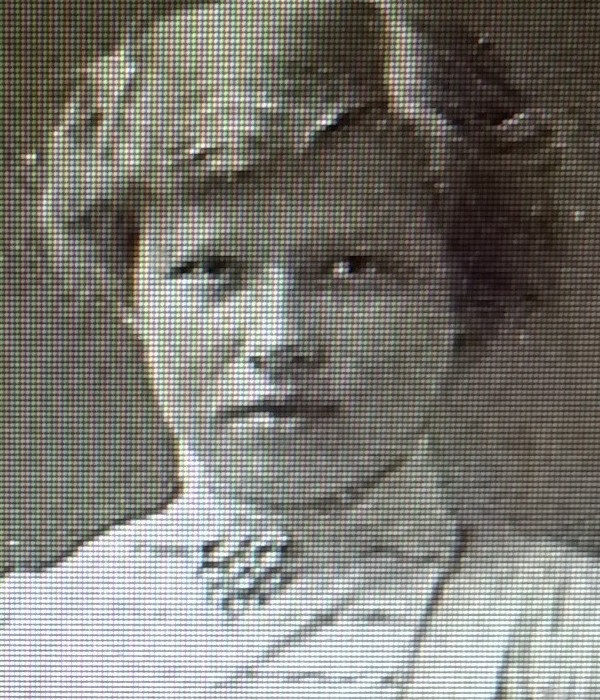
Karen Marie Abelseth — signed portrait, Norway, circa 1911

Karen Marie Abelseth — signed portrait, Norway, circa 1911

Her journey

From a Norwegian fjord to the California sun

1895 Ørskog, Norway

Born in the Norwegian fjords

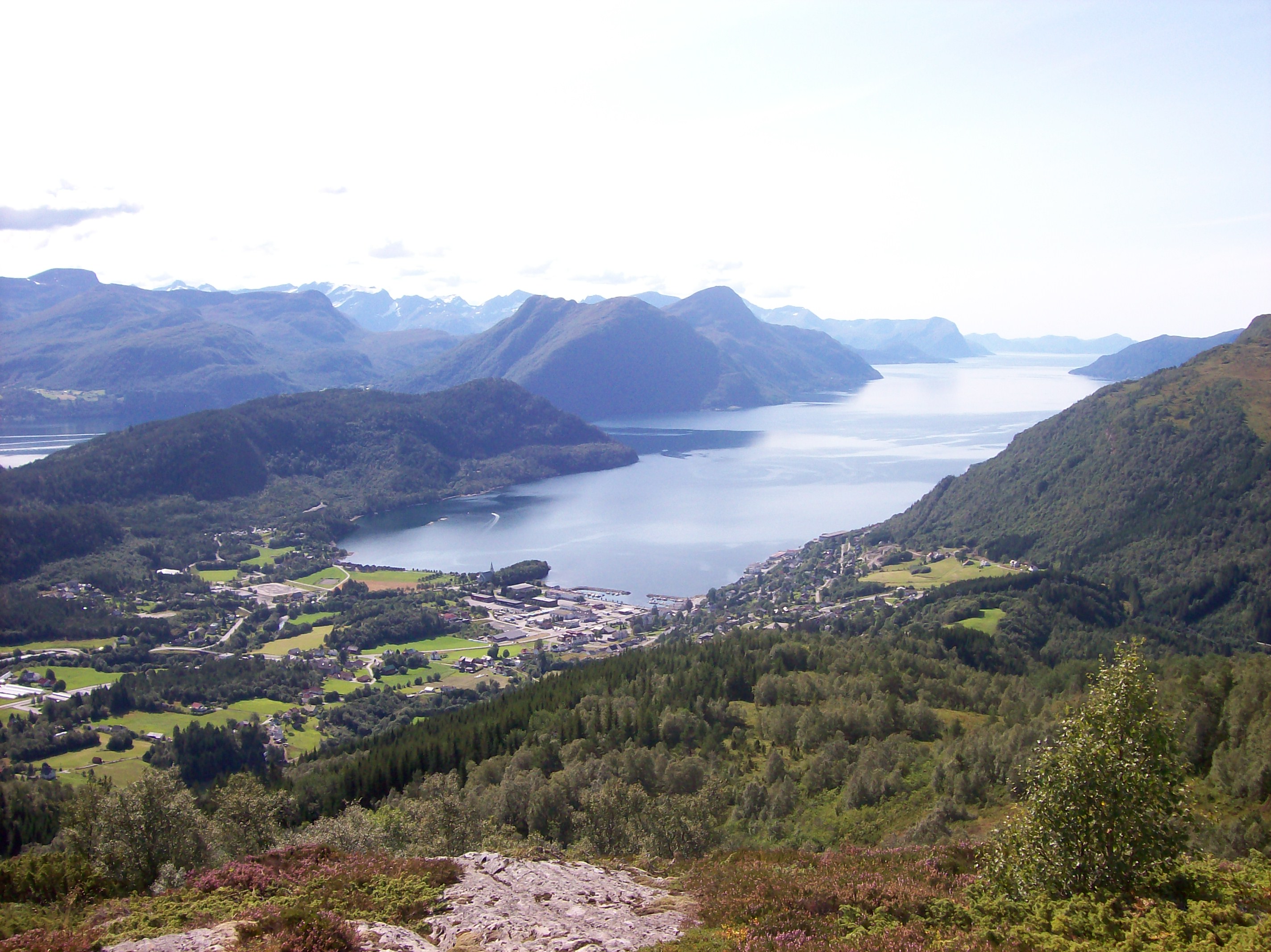
She was born Karn Marie Kristiansdatter Abelseth on September 14th in Ørskog, Søndmøre, Norway — the fourth of nine children born to Iver Kristian and Nikoline Petrine (Tosse) Abelseth. The family home sat in the village of Sjøholt, nestled among the fjords and mountains of western Norway. Her mother passed away when Karen was twelve years old.

A note on Norwegian naming. In Norway at this time, children did not inherit a family surname as Americans do today. Daughters took their father's first name with "datter" added — making her Kristiansdatter, meaning "daughter of Kristian." Abelseth was not a family surname but a farm name, referring to the farm where the family lived. When she emigrated to America she became Karen Marie Abelseth — simpler, more American, but carrying a little less of Norway in the translation. Karn was the name her father called her. In America she was also known as Katie, her husband Harry called her Kalla, and her grandchildren called her Nama.

Sjøholt, Norway — Karen's birthplace, viewed from the mountains above the fjord

Sjøholt, Norway — the fjord village Karen left behind at sixteen

1911–1912 Søndmøre, Norway

Final school year

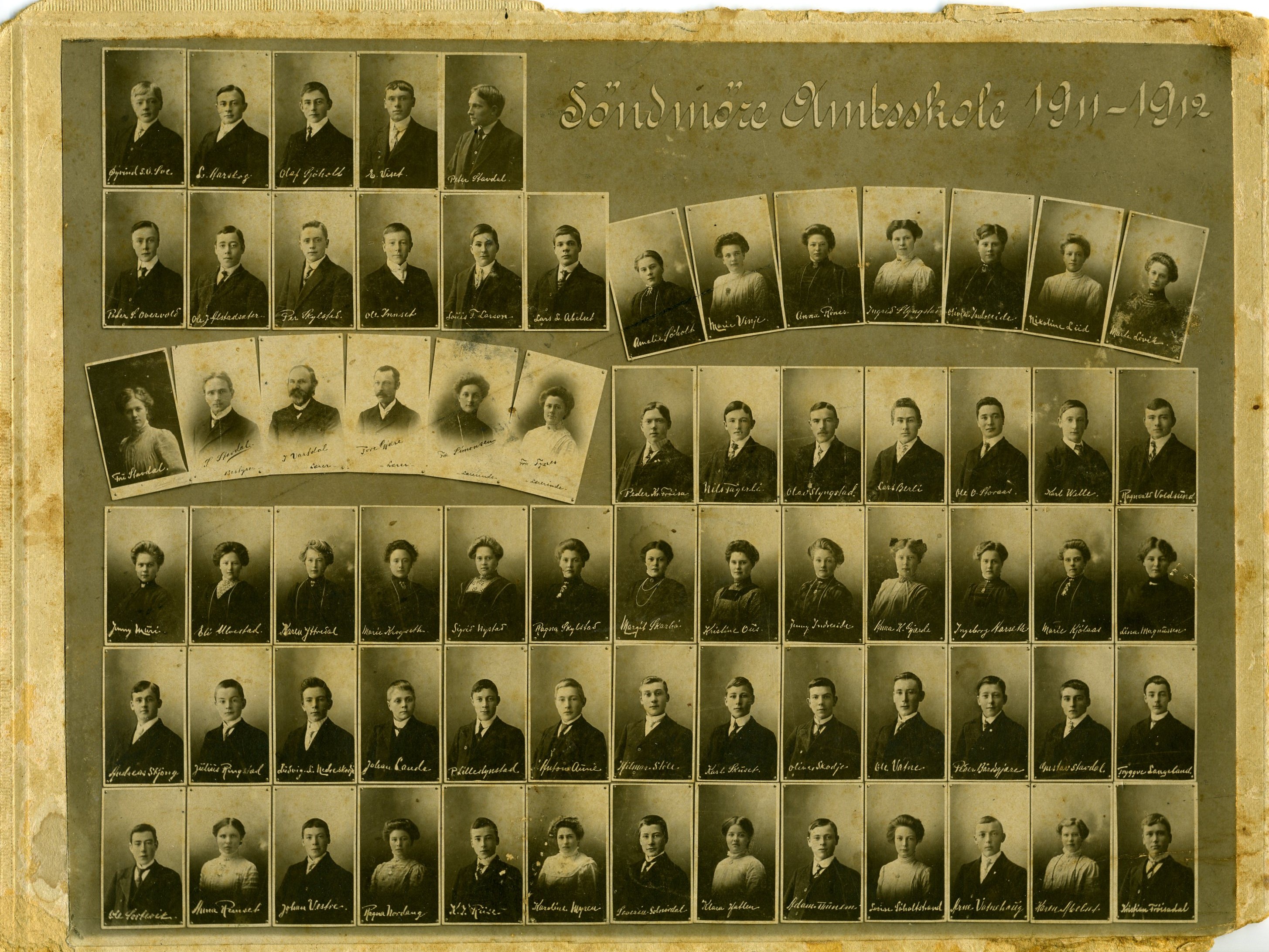
Karen attended Søndmøre Amtsskole for her final year of schooling. The school allowed her to take her final examinations early so that she could emigrate to America — she finished her education properly before she left, doing things the right way before embarking on her great adventure. The class photograph was taken during 1911–1912 — just months before she would board the Titanic. When a trusted family friend, Olaus Abelseth, arranged to return to America in the spring of 1912, her father seized the opportunity to send her safely in his company.

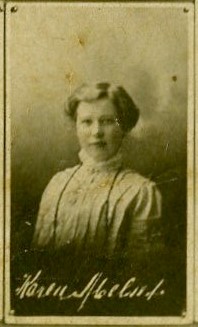
Karen Abelseth — calling card portrait, Norway

Karen's calling card portrait — her own signature below

Søndmøre Amtsskole class photo 1911–1912 — Karen is second from right in the bottom row

Søndmøre Amtsskole, 1911–1912 — Karen is second from right, bottom row

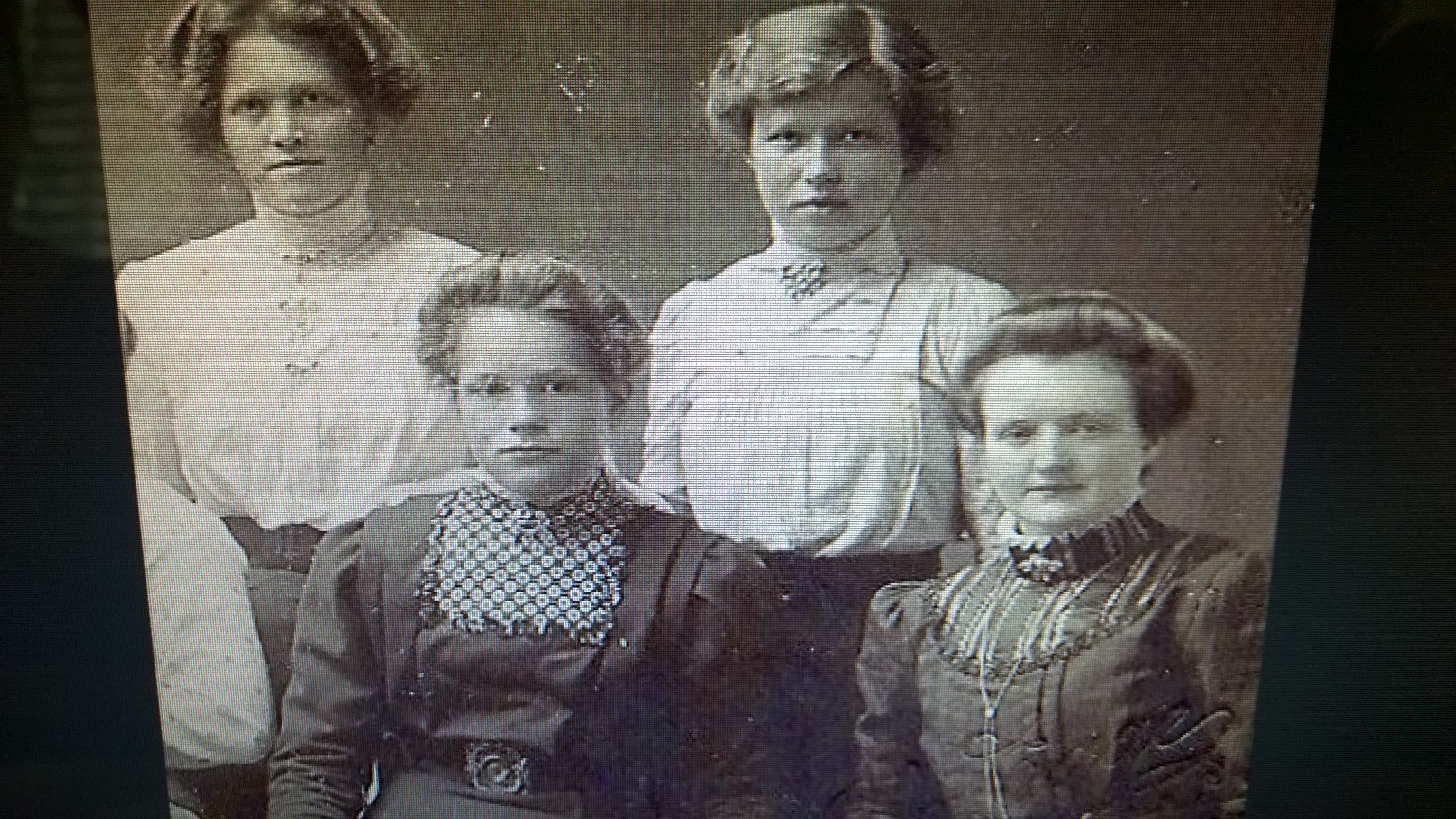
Karen Abelseth with three other young Norwegian women — Norway era

Karen with friends in Norway, before her departure for America

April 1912 RMS Titanic

The Titanic

The journey to the Titanic began in Ålesund, Norway. On April 5, 1912, all six — Karen, Olaus, Sigurd Hansen Moen, Peter Søholt, Anna Salkjelsvik, and Adolf Humblen — departed together aboard the Erling Jarl, sailing from Ålesund to Bergen, then on to Newcastle. Adolf Humblen was the brother of their schoolteacher back home, so Karen knew who he was. Anna Salkjelsvik was the only one Karen had not previously known — she joined them at Ålesund, traveling with Adolf as her companion. The six boarded the RMS Titanic together at Southampton on April 10, 1912 as third class passengers. Karen was sixteen years old. Her ticket number was 348125, which cost £7 13s. Her destination was 848 East Adams Street, Los Angeles, California, where her sister Anna was waiting for her. The group shared close connections — Sigurd Moen was married to Olaus's sister Inge, Peter Søholt was Olaus's cousin, and Olaus had been entrusted by Karen's father to see her safely to America. The women — Karen and Anna — shared a cabin together in the stern of the ship, as was the arrangement for single women in third class. The men were berthed separately at the bow — the opposite end of the Titanic entirely. On the night of the sinking, when the men realized something was wrong, they traveled the full length of the ship through Scotland Road on E Deck in the dark to reach the women's cabins at the stern. That journey — the length of the Titanic — is what brought Adolf Humblen to Karen's bedside in time to wake her up.

On the night of April 14th, Karen was asleep when the ship struck the iceberg. She was woken by a traveling companion. The Norwegian men escorted her to the lifeboats. She was placed in Lifeboat 16 — one of the last boats lowered from the port side of the ship. As she recalled to her family, she believed she was in the last lifeboat.

A 1916 Goldfield, Nevada newspaper account of her marriage described a dramatic scene at the lifeboat — with a ship's officer intervening to protect her place. As was common in small-town reporting of the era, the account was sensationalized, but it reflects the story Karen herself was telling just four years after the sinking.

Karen was rescued by the RMS Carpathia and arrived in New York on April 18th. During the sinking, Karen and Anna had been separated — Karen was placed in Lifeboat 16 on the port side, while Anna escaped in Collapsible C on the starboard side — the last lifeboat to successfully lower from the ship, with Anna among its passengers. Both women had cut it to the very last possible moment, on opposite sides of a sinking ship, and neither knew if the other had survived. It was only aboard the Carpathia, going through a corridor, that Karen found Olaus alive — and was reunited with Anna. The two women who had shared a cabin on the Titanic — strangers when they boarded, bound together by that night — who had faced that night together and been torn apart by it, found each other again on the rescue ship. As Karen wrote to her father: she didn't see any of her company except Anna — and then there was Olaus. She spent time recovering at St. Vincent's Hospital in New York before continuing her journey.

Karen never spoke of the Titanic to her children or grandchildren. As children, they were instructed never to ask — it was too distressing to her.

April 1912 The North Atlantic

The men who saved her life

Karen did not reach that lifeboat alone. Three men made it possible — and without them, she would not have survived, and many of us would never have taken our first breaths.

Adolf Humblen

It was Adolf Humblen who stood at Karen's bedside at midnight and woke her. Without that moment, she would never have reached the deck. He was the first link in the chain that saved her life. Karen wrote in her letter: "Adolf Humblen stood in front of my bed and said that I must hurry up because we had hit an iceberg." He was the brother of the group's school teacher and known for his extraordinary kindness — bringing food and fruit to the group when they were too ill to go to the dining room. He did not survive the sinking. Anna, Karen's traveling companion, lost him that night — he had been her companion on the voyage.

Sigurd Hansen Moen

When Karen came out of her cabin terrified and could barely stand, it was Sigurd who held her up. He escorted her to the lifeboat. When she didn't want to get in — when it meant leaving the men behind — Sigurd told her: "Just be strong. It will all end well." Those were the last words he ever said to her. Sigurd Moen did not survive the sinking. He is buried in Norway. Karen nearly cried herself sick over his loss, and wrote of him in her letter: "Oh, Sigurd! He isn't any more — he who was so kind to me."

Olaus Jørgensen Abelseth

Olaus had promised Karen's father he would look after her on the voyage to America. He kept that promise. He escorted her to the lifeboat alongside Sigurd and Peter, and watched as she was lowered to safety. Olaus survived the sinking and went on to build a life in America. He remained part of Karen's life for decades afterward — visiting her at the family home in Inglewood, California. His daughter and Karen's daughter Wanda became very good friends and spoke frequently through the years. Karen's grandson met Olaus on one of those visits. The bond between these two families, forged on the deck of the Titanic, lasted a lifetime.

A note on the name: Olaus Abelseth and Karen Abelseth shared the same surname but were not related. Both came from the same farming community in Ørskog, Norway — Abelseth was a farm name, not a family name. Under the Norwegian naming convention of the era, anyone living on or connected to the Abelseth farm carried that name. Their shared surname has caused confusion among researchers for over a century.

Sigurd Moen was married to Olaus Abelseth's sister Inge. He was 25 years old when he died. Karen's letter to her father — written just six weeks after the sinking — is in part a tribute to Sigurd, and to the kindness he showed a frightened sixteen-year-old girl in the worst night of both their lives.

1915 Oregon, USA

First days in America

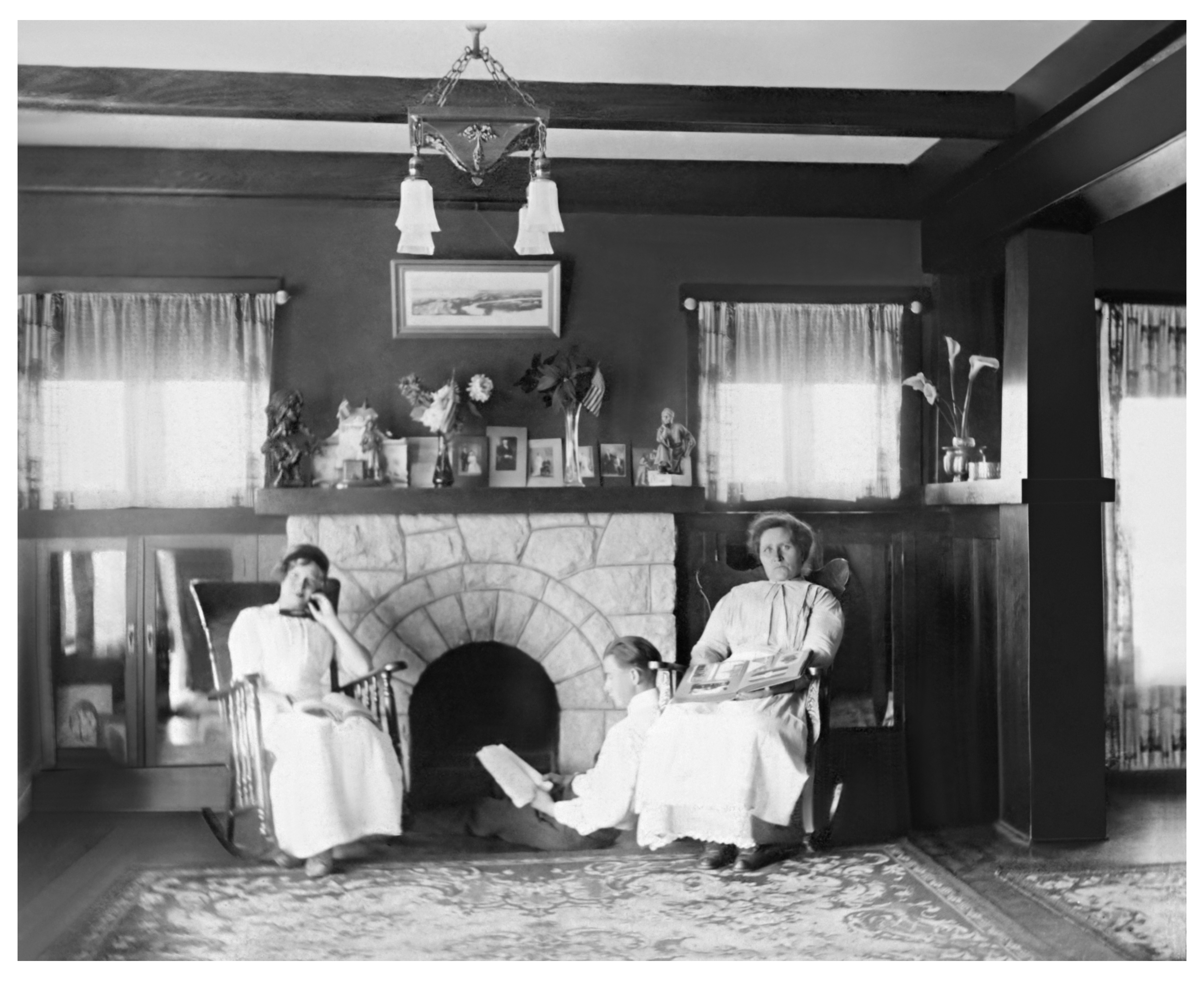
The earliest photograph we have of Karen in America shows her visiting her Aunt Lovise in Oregon — sitting by the fireplace in a warm, well-furnished home. Three years after surviving the Titanic, she is settled and calm. She has built a life.

Karen visiting her Aunt Lovise in Oregon, 1915

Karen (left) visiting Aunt Lovise in Oregon, 1915 — her first documented moment in America

1916 Goldfield, Nevada

Life in the gold rush boomtown

Karen settled in Goldfield, Nevada — at its peak the largest and most vibrant city in the state, a gold rush boomtown with 49 saloons, 22 hotels, and characters like Wyatt and Virgil Earp walking its streets. She married Harry Sylvester Little here in 1916. Their first child, Phyllis, was born in Goldfield. Their closest friends in Goldfield were Roy and Jo, who served as witnesses at their wedding and remained dear friends for the rest of their lives — still together with Harry and Karen at their 50th wedding anniversary.

Harry worked at the mining company store, and Karen found work at a local laundry — ironing and folding shirts. Decades later, long after Goldfield was behind them, Harry's shirts were still the neatest and most crisply pressed you'd ever see. Beyond work, Harry was a talented drummer who played in the band at the community dances, and like many Goldfield men, took part in the town's baseball league. He was also said to have played in the celebration band when Arizona achieved statehood on February 14, 1912 — just two months before Karen boarded the Titanic. Small town life in a big Nevada sky.

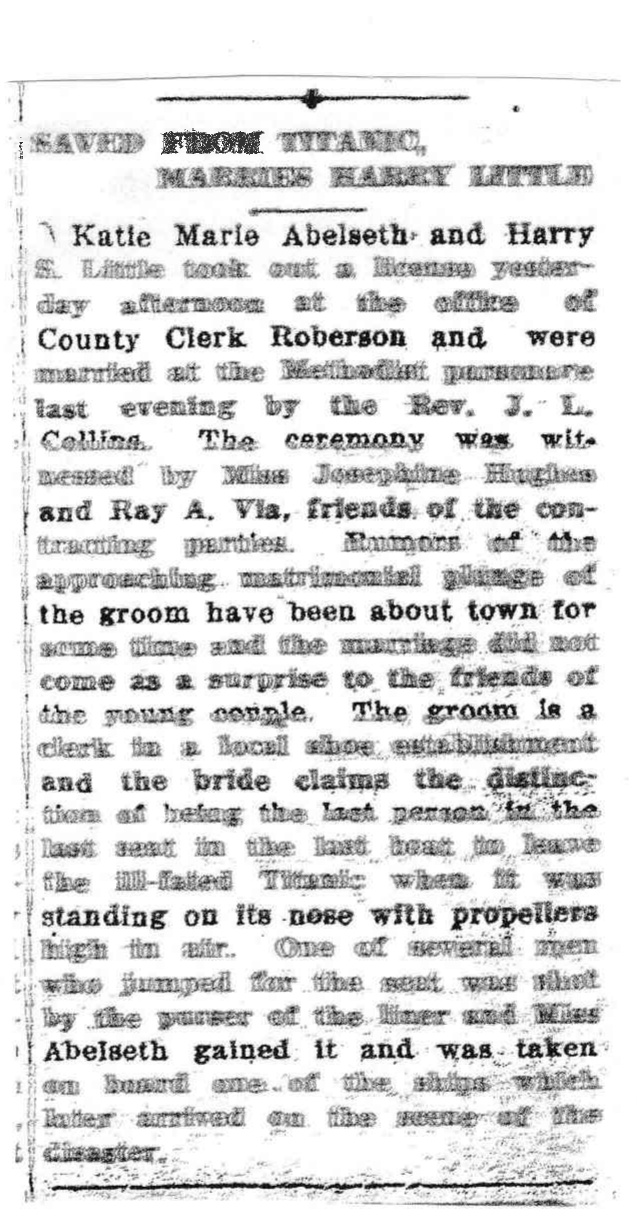
The Wedding Announcement. Four days after the wedding, the Goldfield News and Weekly Tribune of April 8, 1916 ran the following notice — confirming Roy and Jo as the witnesses, and offering a glimpse of the story Karen was telling about that night on the Titanic:

"Katie Marie Abelseth and Harry S. Little took out a license yesterday afternoon at the office of County Clerk Roberson and were married at the Methodist parsonage last evening by the Rev. J. L. Collins. The ceremony was witnessed by Miss Josephine Hughes and Ray A. Via, friends of the contracting parties. Rumors of the approaching matrimonial plunge of the groom have been about town for some time and the marriage did not come as a surprise to the friends of the young couple. The groom is a clerk in a local shoe establishment and the bride claims the distinction of being the last person in the last seat in the last boat to leave the ill-fated Titanic when it was standing on its nose with propellers high in air. One of several men who jumped for the seat was shot by the purser of the liner and Miss Abelseth gained it and was taken on board one of the ships which later arrived on the scene of the disaster."

Goldfield News and Weekly Tribune, April 8, 1916. Via Encyclopedia Titanica.

Roy A. Via and Josephine Hughes. Among everything that Goldfield gave Karen and Harry — a marriage, a first child, a new life in the American West — perhaps its most enduring gift was two friends. Roy and Jo stood as witnesses at their wedding in 1916, and fifty years later they were still there, together with Harry and Karen at their golden anniversary. They never had children, and history has little else to record about them. But they were important — the kind of friends who show up at the beginning and are still standing beside you at the end. This page exists in part so that Roy and Jo are not entirely lost to time.

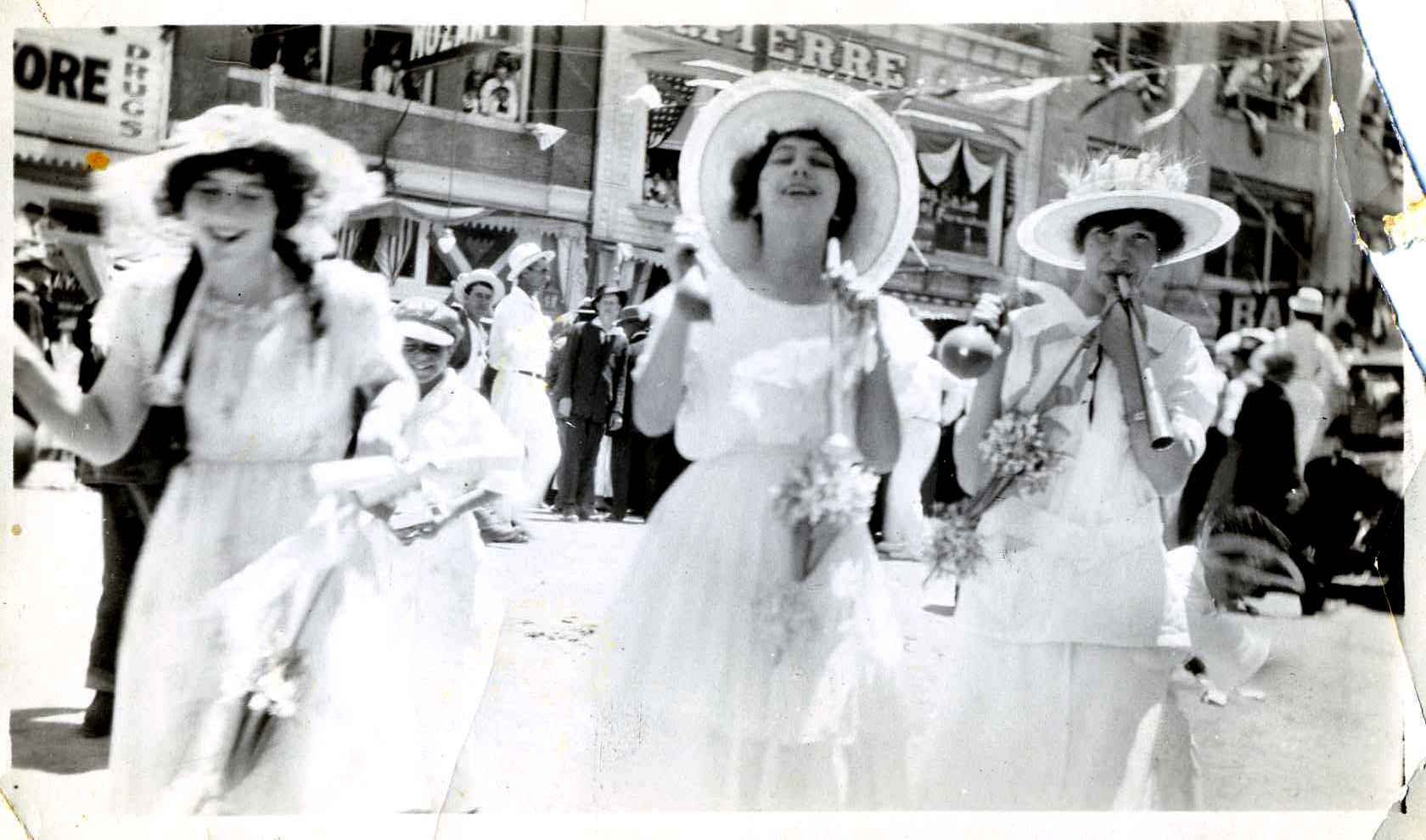
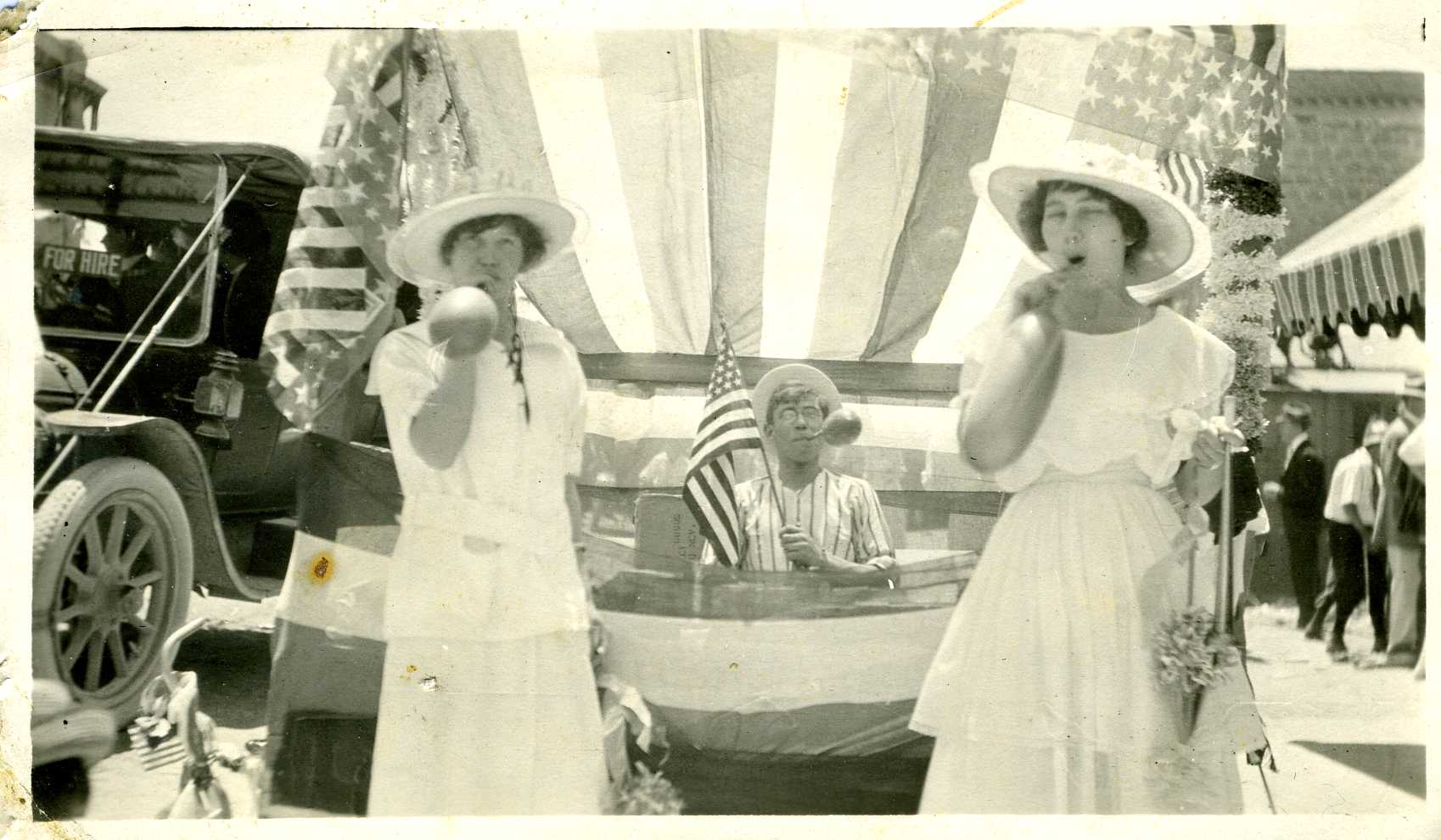
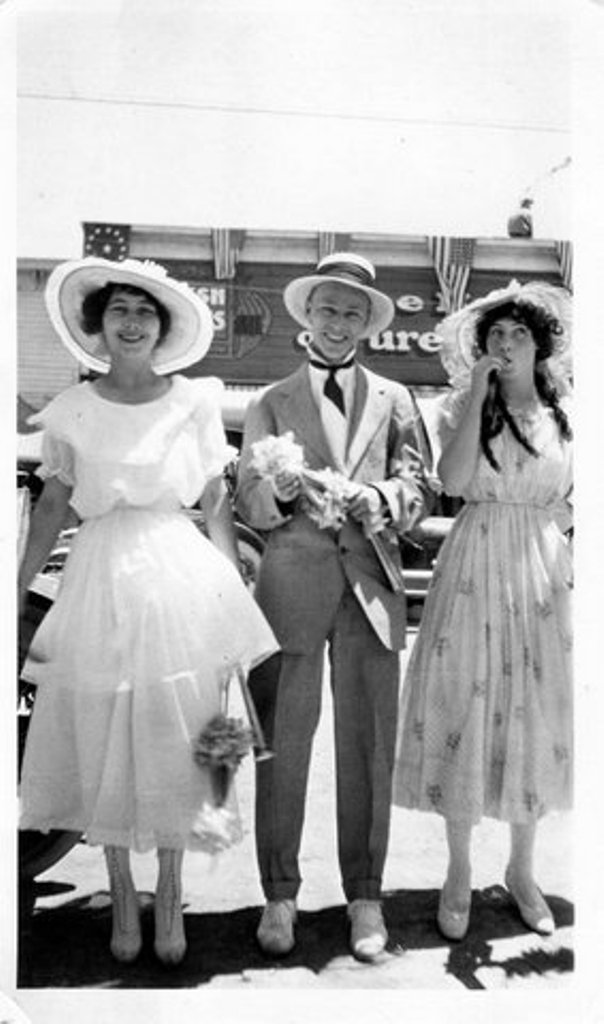
On July 4th, 1916 — likely her first Fourth of July as a married woman — Karen marched in the Independence Day parade down Goldfield's main street in her white dress and wide-brimmed hat, blowing a party horn and carrying flowers. She bumped into something that day and chipped her tooth on the horn. A Norwegian girl who survived the Titanic, celebrating America in a Wild West gold rush town.

Karen in the July 4th parade, Goldfield Nevada, 1916

Karen (right) and Jo (middle) in the July 4th parade, Goldfield, 1916 — the day she chipped her tooth on that horn

Karen (left) on a Fourth of July float in Goldfield, Nevada, 1916

Karen (left) and Jo (right) on the Independence Day float, Goldfield, 1916

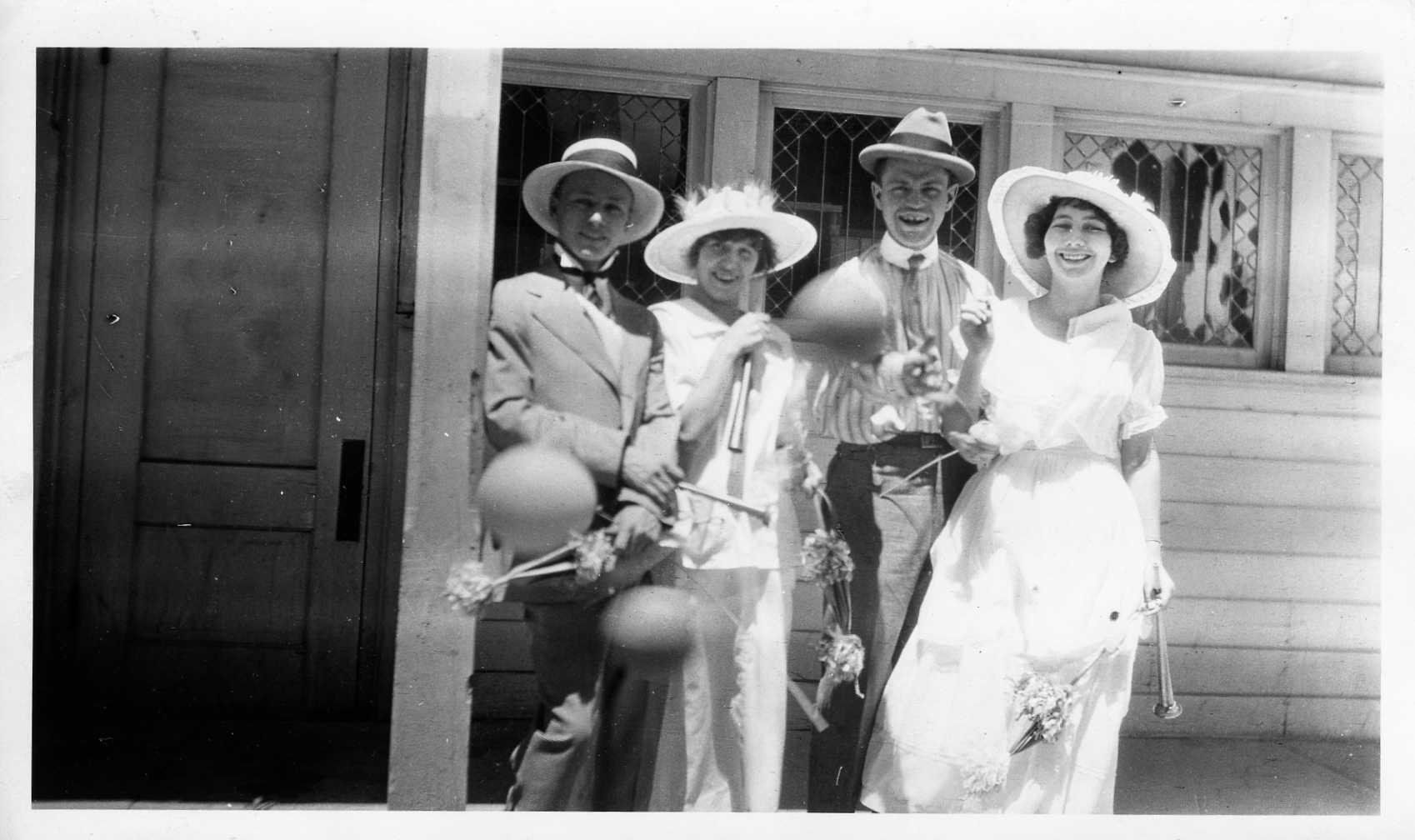
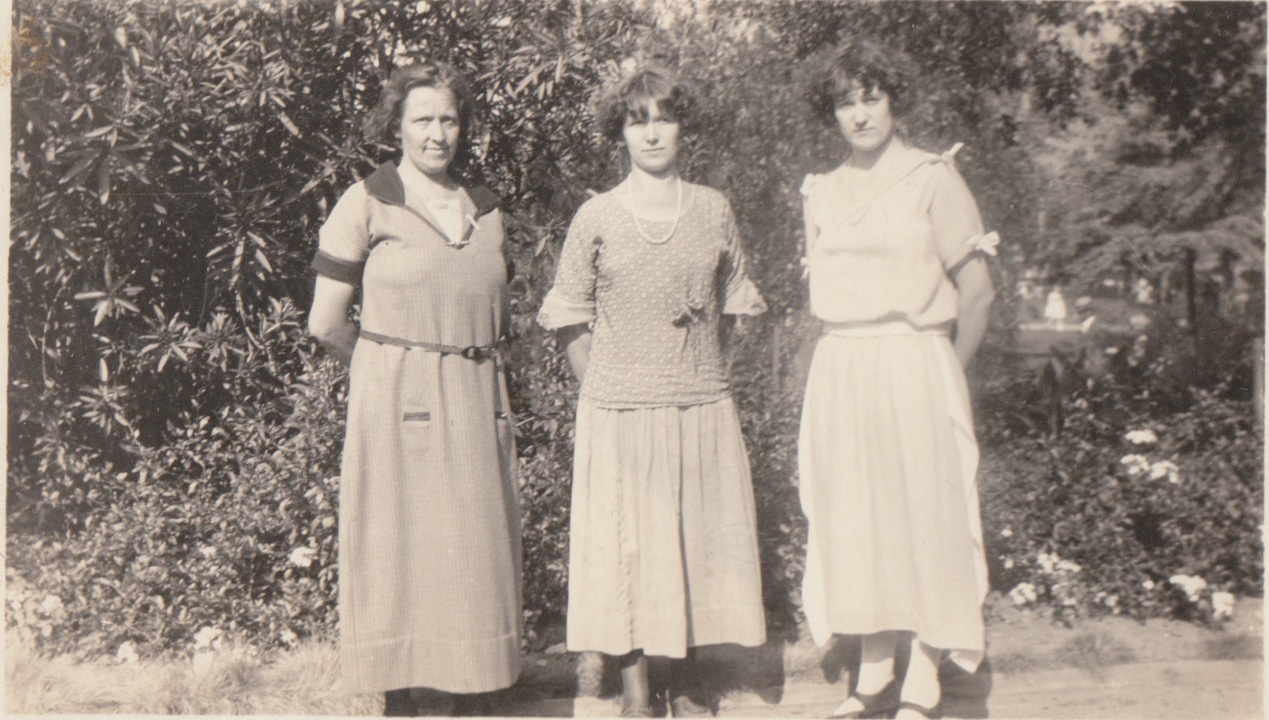
Harry and Karen Little with Roy and Jo, Goldfield 1916

Harry, Karen, Roy, and Jo, Goldfield, 1916 — witnesses at their wedding and lifelong friends

Harry Little with Jo and an unknown woman, Goldfield 1916

Harry with an unknown woman (left) and Jo (right), Goldfield, 1916

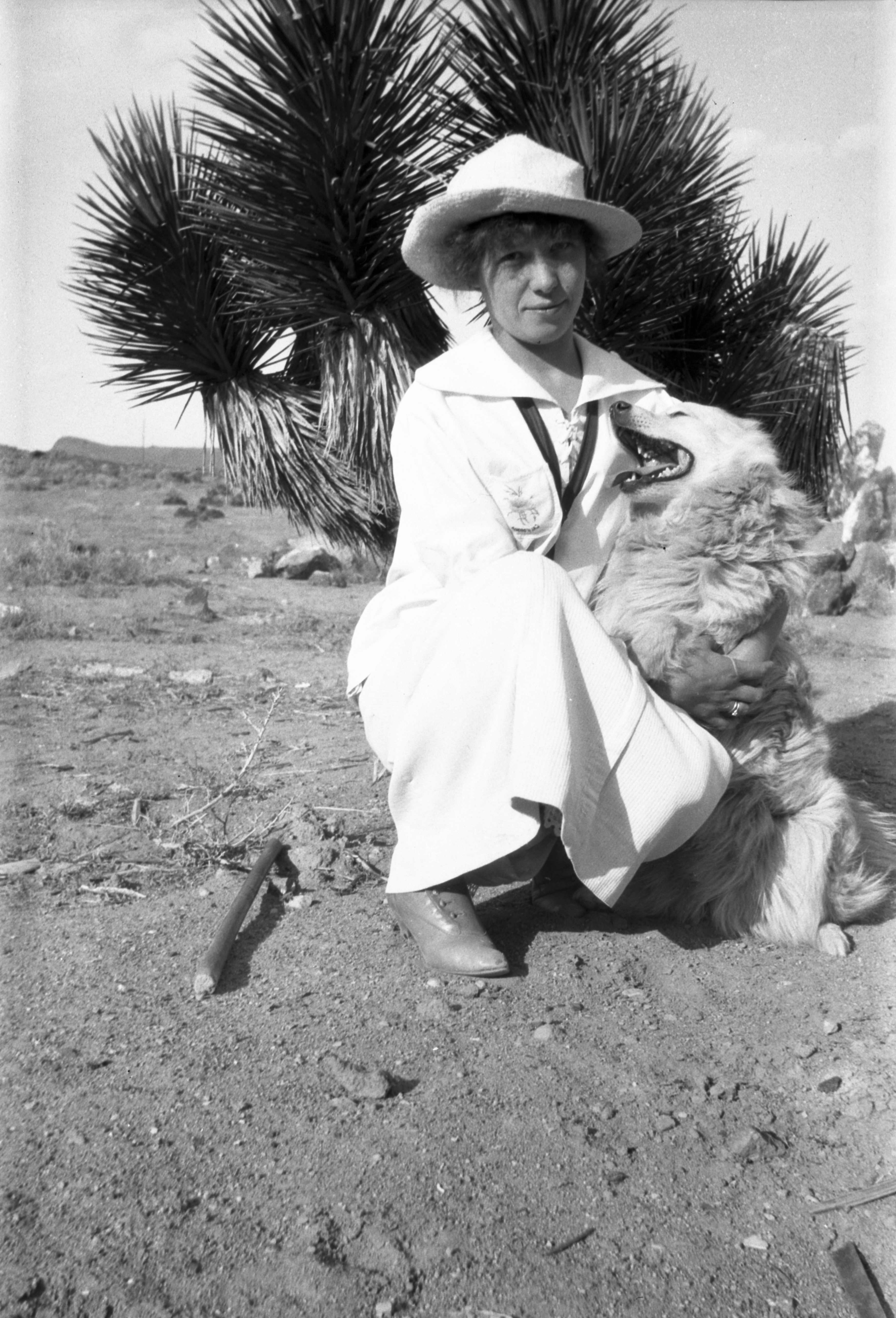
Karen with her dog in the Nevada desert, Goldfield

Karen in the Nevada desert, at home in the American West

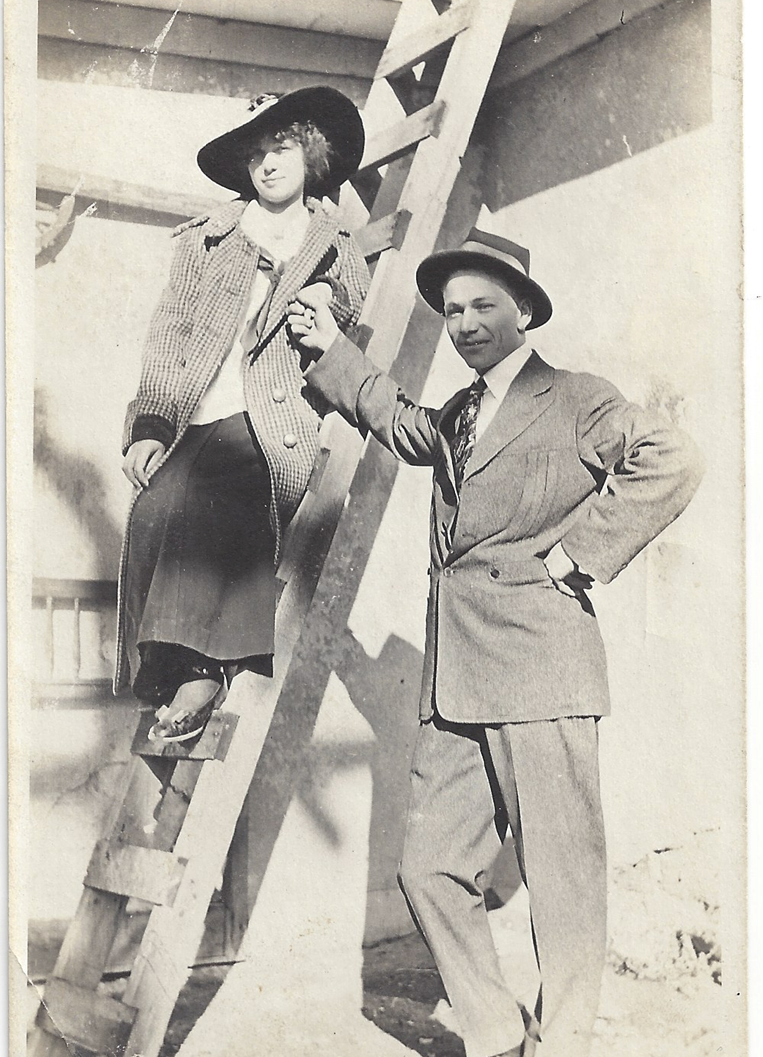
Karen and Harry on a ladder, Goldfield Nevada

Karen and Harry — a playful moment in Goldfield

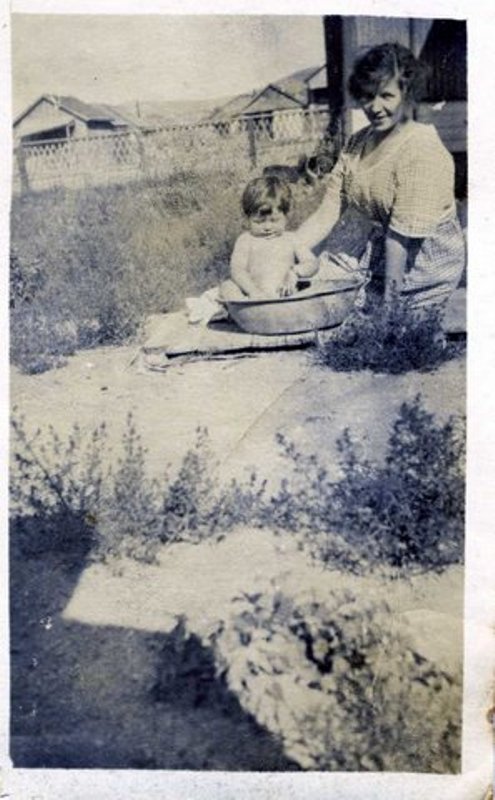
Karen bathing baby Phyllis outdoors in Goldfield, Nevada

Karen bathing baby Phyllis outdoors in Goldfield — their first child, born here

c.1916 Goldfield, Nevada

The Littles of Goldfield

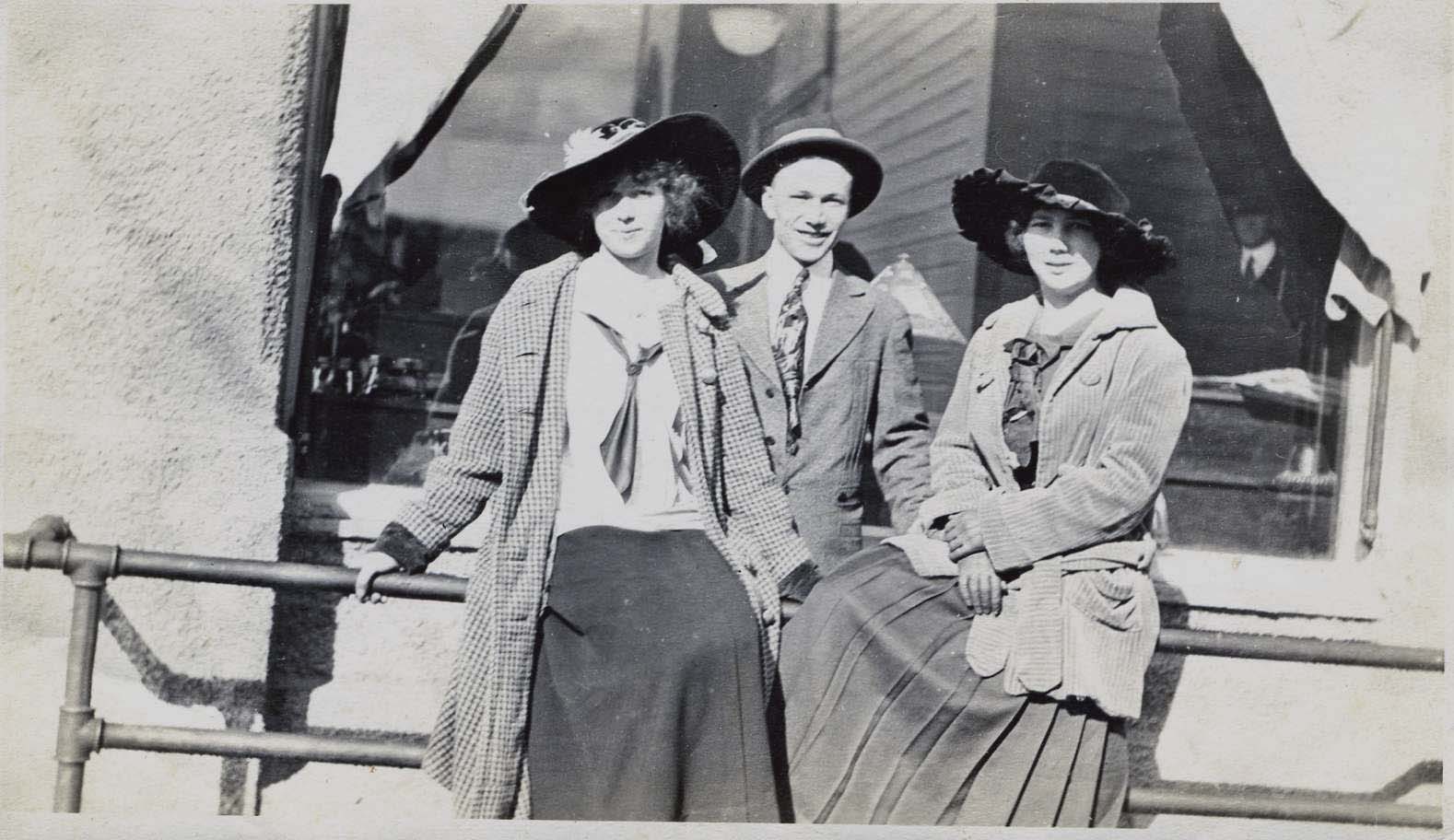
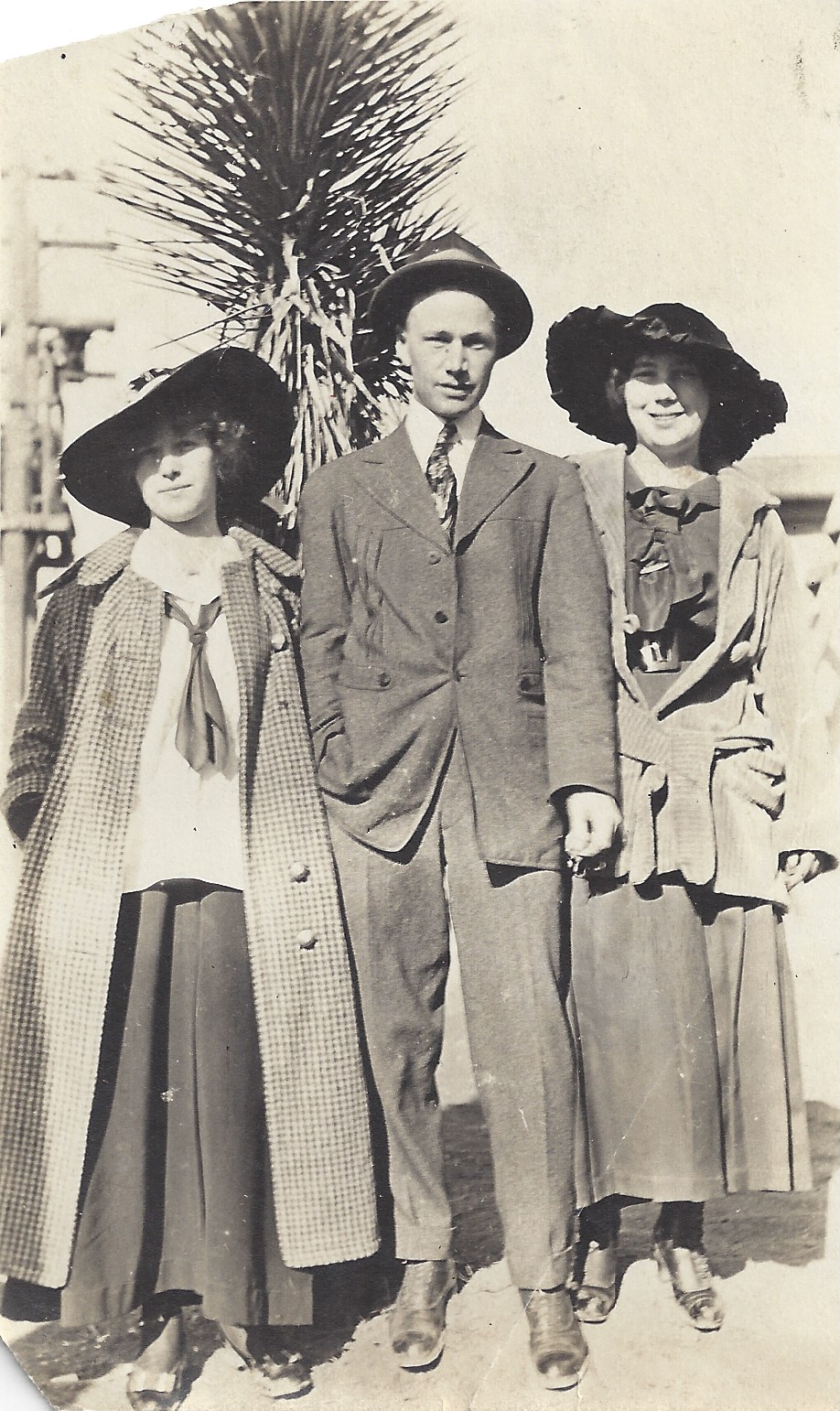
Karen on left, Harry in middle, Goldfield Nevada

Karen (left), Harry (center), and Jo (right), Goldfield

Karen, Harry and Jo in Goldfield Nevada with Joshua tree

Karen, Harry, and Jo — the Nevada desert behind them

c.1923 Inglewood, California

The family settles in California

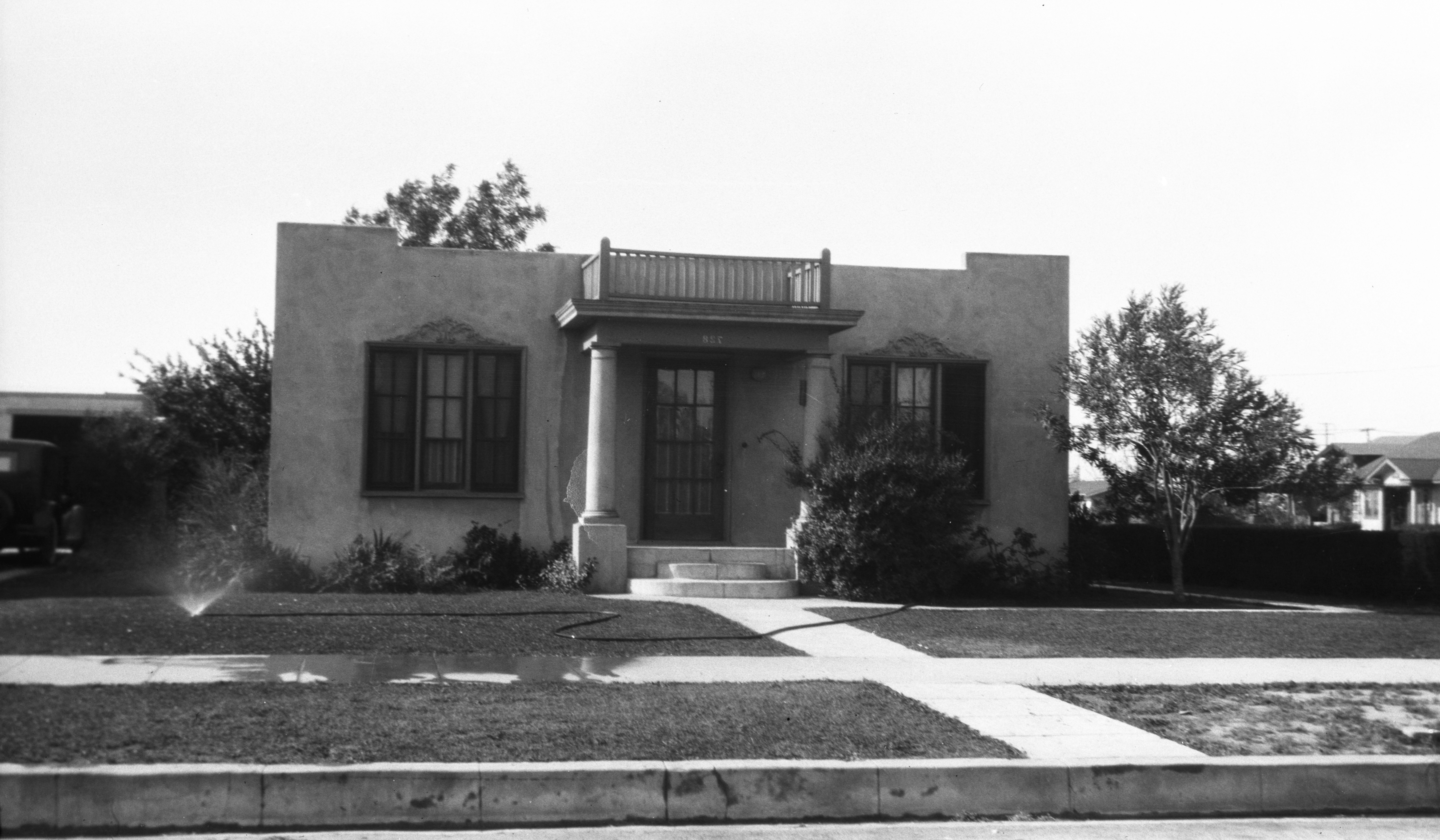
After time in Yerington, Nevada, the Little family made their final home in Inglewood, California. They built a beautiful Spanish Colonial house on a quiet street. Karen raised five children here: Phyllis, Norman, Francis, Wanda, and Iris.

This family photograph was taken looking east from the Inglewood house, circa 1923 — we know this because baby Wanda, born in 1922, is visible in the stroller. Albert Clarence Little (Harry's father, far left) passed away in 1927, confirming how early this photograph is.

The Little family outside their Inglewood home, circa 1923, looking east

The Little family, Inglewood, circa 1923. Back row: Albert Clarence Little, Karen, Harry, unknown. Front row: Wanda (stroller), Norman, Phyllis, Francis. Behind them — the future site of SoFi Stadium.

The Little family home in Inglewood, California

The Little family home, Inglewood, California

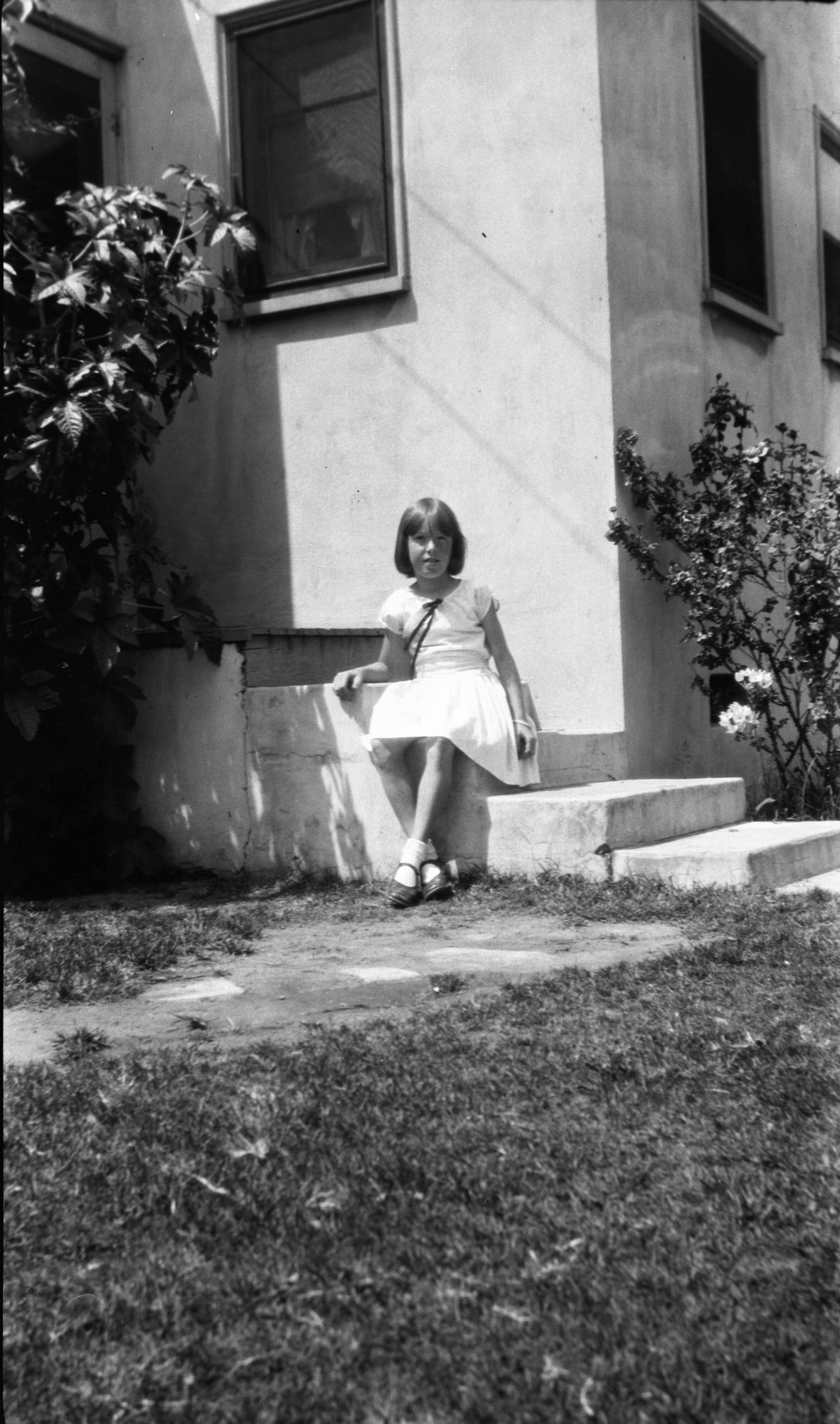
Young Wanda Little on the steps of the Inglewood home

Young Wanda Little on the front steps — the girl who would one day share her mother's story with the world

California years Inglewood, CA

Reunited with her sisters

Karen had been traveling to join her sister Anna in Los Angeles when she boarded the Titanic. She made it — and in California, the Abelseth sisters were finally together. Anna, Karen, and Lisa photographed side by side, in the sunshine that Karen had crossed the world to reach. The youngest sister, Bertha, came later — and all four sisters eventually made their home in Southern California, all of them laid to rest at Inglewood Park Cemetery.

Anna, Karen and Lisa Abelseth together in California

Anna, Karen, and Lisa Abelseth — the sisters reunited in California

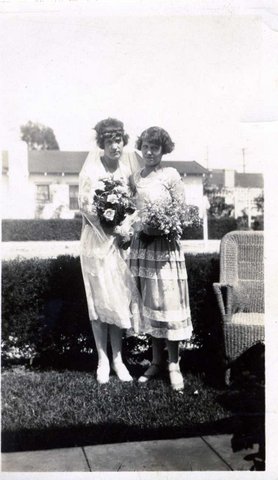
Lisa and Karen Abelseth at a wedding in Inglewood

Lisa and Karen at a celebration in Inglewood

1940s California

The Little family portrait

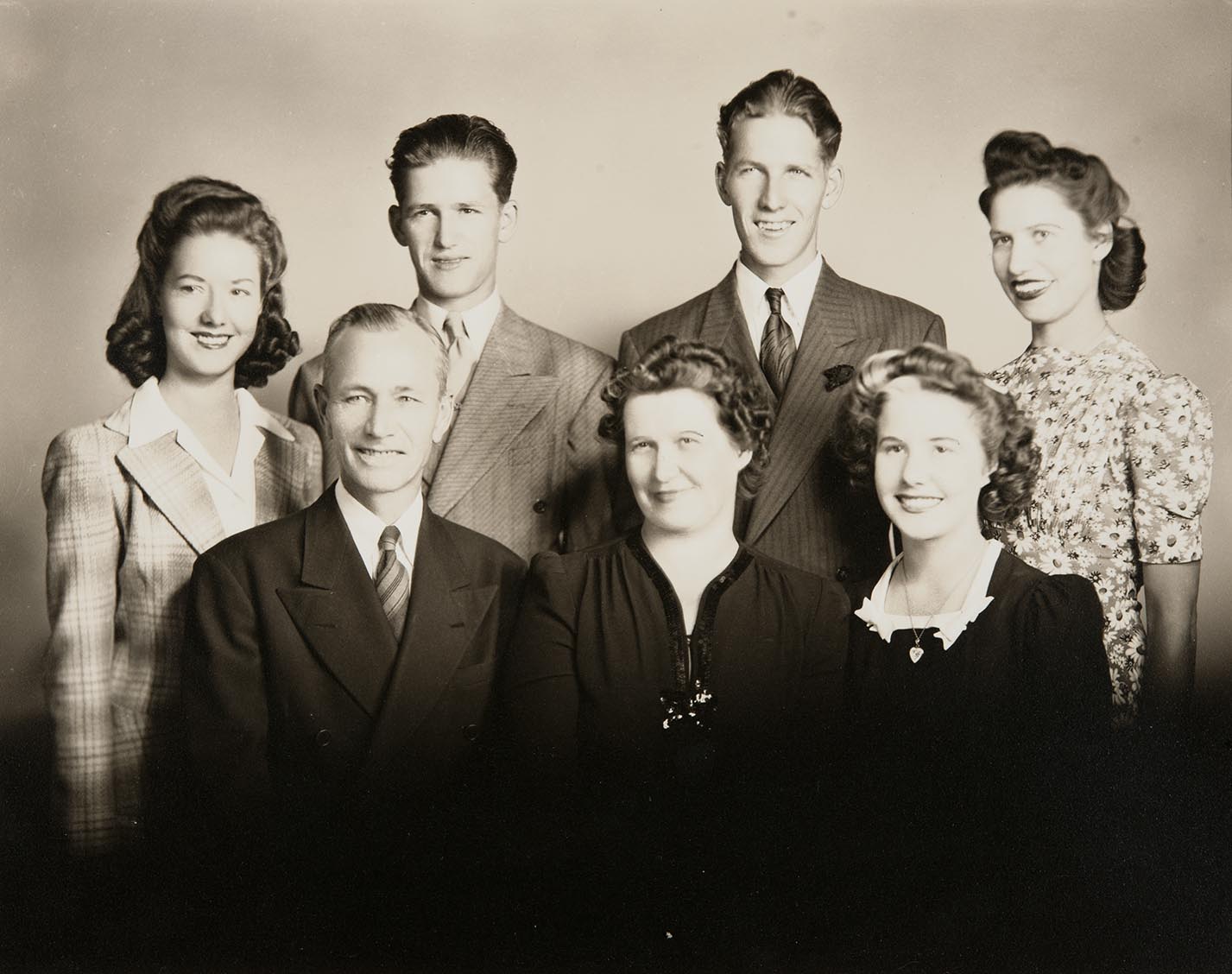
Karen and Harry, surrounded by the five children they raised together. This is what she built — from a Norwegian fjord to the Titanic to a gold rush town to this: a family, a home, a California life.

The Little family portrait — Harry, Karen and their five children

The Little family. Back row: Wanda, Norman, Francis, Phyllis. Front row: Harry, Karen, Iris.

1958 Los Angeles

A Night to Remember — 1958

Forty-six years after the sinking, Karen attended a screening of the 1958 film A Night to Remember with her daughter Wanda. She shook like a leaf throughout. She said nothing — until the moment in the film when the Titanic's lights went out. At that exact moment, she said four words:

"There go the lights."

She had seen those lights go out once before — from a lifeboat in the North Atlantic, on the night of April 14th, 1912. It was the only time Karen ever said anything about that night.

1969 Inglewood, California

Karn — Karen — Katie — Kalla — Nama

Karen Marie Abelseth Little passed away on July 27, 1969, in Inglewood, California, from the effects of Parkinson's disease. She was 73 years old. She is buried at Inglewood Park Cemetery. Her grandchildren called her Nama. Her husband Harry called her Kalla. Her father had called her Karn. She was sixteen when she survived the Titanic, and she never spoke of it again.

The letter

Written from St. Vincent's Hospital
May 28, 1912

While recovering at St. Vincent's Hospital in New York, Karen wrote a letter to her father back in Norway. She wrote it in Norwegian. It described what she had witnessed and survived on the night of April 14th. She never spoke of the Titanic to her children or grandchildren — but she wrote it all down, once, for her father, and then kept it to herself for the rest of her life.

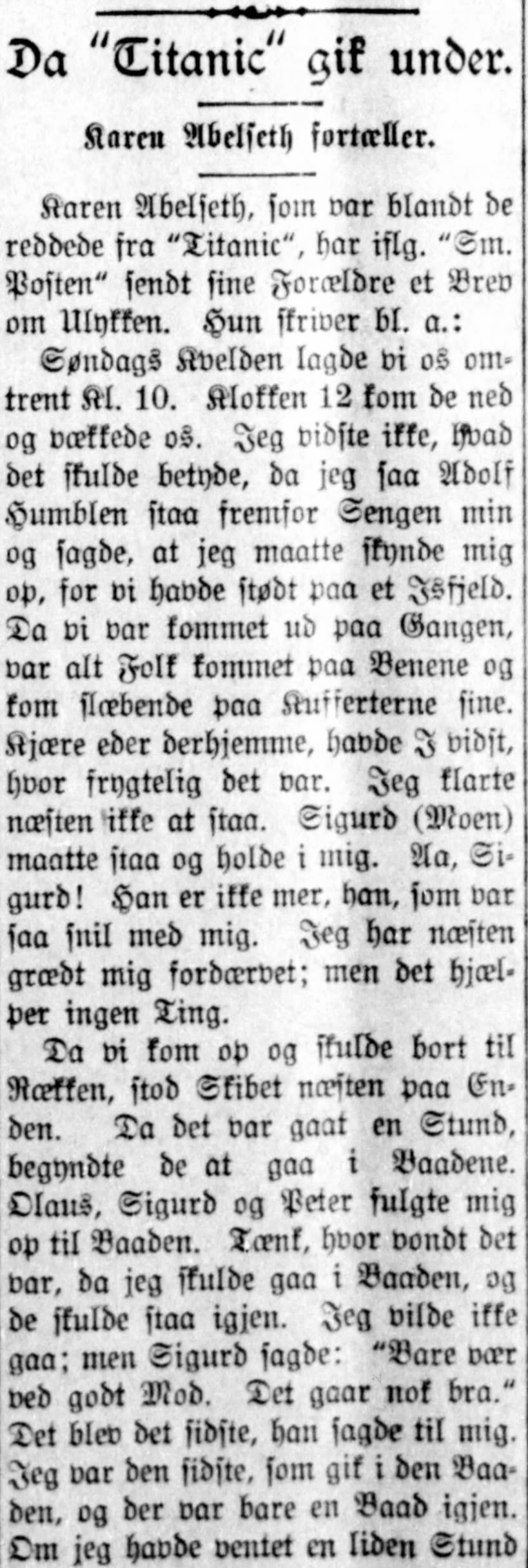
The letter was published in a Norwegian newspaper in 1912 under the headline Da "Titanic" gik under — "When the Titanic went down" — with the subtitle Karen Abelseth fortæller — "Karen Abelseth tells her story." The letter was unknown to Karen's American family for decades, until it was discovered by Norwegian researcher Per Kristian Sebak.

English translation — Per Kristian Sebak

Norwegian newspaper clipping — Da Titanic gik under — Karen Abelseth fortaeller — 1912

Da "Titanic" gik under · Karen Abelseth fortæller · Søndmørsposten, 1912

St. Vincent's Hospital, New York City

Well, now I must try to write some words to you, so that you can hear that I'm alive. Oh, it has been a terrible time. The experience that I have had since I left you. If I had only known, I would never have traveled. Suppose I must tell you something about what has happened.

Sunday evening we went to bed at about 10. At 12 o'clock they came down to wake us up. I didn't know what it meant when Adolf Humblen stood in front of my bed and said that I must hurry up because we had hit an iceberg. When we had come out in the corridor, many people had already got up and were dragging their suitcases along. Dear you at home, had you only known how terrible it was. I hardly managed to stand. Sigurd had to stand and hold me. Oh, Sigurd! He isn't any more, he who was so kind to me. I have almost cried to pieces, but it doesn't help at all.

When we came upstairs and went over to the railing, the ship was tilting heavily. After a while, people began to enter the lifeboats. Olaus, Sigurd and Peter followed me up to the lifeboat. Just think how hard it was when I was to enter the boat, and they had to stay behind. I didn't want to enter, but Sigurd said: "Just be strong. It will all end well." That was the last he said to me. I was the last who went in that lifeboat, and there was only one lifeboat left. If I had waited any longer, you would never have heard from me anymore.

Then we were lowered. The others had to stay behind. I wish that I was there, and that somebody else could be saved.

When we had come a short distance away from the ship, we saw how it started to sink. At the end we heard a terrible noise, and "Titanic" went under with over 2000 people. As soon as it sank there was a terrible scream. Oh, if only you could have heard it. I will never in my life forget it. I thought I was going to lose my mind, the way they cried. Imagine when so many people start to call for help, and no one can give them any assistance. First "Titanic" sank, then she resurfaced close to where we were, and overturned twice. We heard the cries for many hours. Those were the worst hours I have ever experienced, and I hope I will never experience such a thing again. Imagine, those cries, those cries.

At 6 o'clock we saw a ship far away, and then we were very glad, as you can imagine. We came alongside the ship at 7 o'clock. There we got blankets around us. But it didn't matter, I thought, because I didn't see any of my company, except Anna, the girl who joined us in Åalesund. After a while we went through a corridor. There was Olaus. You can imagine there was joy. I wouldn't have had an ore if he was not saved. But Sigurd and Peter were not there. I have hardly tasted any food since I was on board the "Titanic".

Now there was a nice young lady here and she took me on her lap and was so kind to me. We are at a hospital. Here everything is so sad. They are only speaking English, every one. Anna is sitting and writing, and Olaus is ill. It was so hard for him that Sigurd was not to be saved. "Oh, had it only been me who died in his place," he says. You should have seen how much he is crying sometimes. Just imagine what would have happened to me and Anna, if he had drowned as well.

Anna also lost her companion. That was Adolf Humblen, brother of our school teacher. He was so kind, so kind. Everybody was kind. One day we were ill, so we could not go downstairs to eat. They then first came with food, and then with all kinds of fruit, and we had such a nice time. Then the dreadful thing was going to happen.

Many tears have fallen down on this paper. It isn't easy making sense of what I'm writing today, because I have got a terrible headache. I have difficulties writing to the others, but will make up for it when I arrive.

— Translation by Per Kristian Sebak, from his research into the 31 Norwegian passengers aboard the RMS Titanic. Sebak interviewed Karen's daughter Wanda Martin for his research. Reproduced here with the family's knowledge and full credit to Per Kristian Sebak.

Discovered and researched by Per Kristian Sebak

The letter was discovered by Norwegian author and historian Per Kristian Sebak during his years of research into the 31 Norwegian passengers aboard the RMS Titanic. Sebak traveled to California to personally interview Karen's daughter, Wanda Martin, for his book. The translated letter and family account that have circulated on Titanic websites originate entirely from Sebak's research and his interview with Wanda. He deserves full credit for bringing this story to light.

His book — Titanic: 31 Norwegian Destinies (1998) — remains the most thorough account of the Norwegian passengers on the Titanic, and contains more than 140 photographs, most never previously published in English. It took Sebak four years to complete.

Find the book on Amazon →

The family

Harry and Karen's five children

Karen and Harry Sylvester Little raised five children in Inglewood, California. Their daughter Wanda Martin — the family's keeper of Karen's story — lived to 100 years old. It was Wanda who was interviewed by Per Kristian Sebak, and Wanda who traveled with her brother and his wife to visit Sjøholt, Norway — the fjord village her mother had left behind at sixteen and never returned to.

P

Phyllis Kalla Little (Fabri)

N

Norman Harry Little

F

Francis Clarence Little

W

Wanda Mae Little (Martin)

I

Iris Ellen Little (Wild, Roeder)

The authoritative family record

This website was created by one of Karen's grandsons. We lived the closest to my grandparents — and while my mother worked, I stayed with them. When my father became very ill with cancer and could no longer work, we moved in with my grandparents entirely.

My grandmother had Parkinson's and eventually fell and broke her hip — a death sentence in those days. She became bedridden and passed away. Then my father. Then my grandfather suffered a stroke while watching television in the living room and passed a few days later. My mother cared for all three of them. All of this happened during my high school years.

When my grandmother died, it broke my grandfather's heart. He went from being that perfect grandfather — the man who taught me how to build birdhouses and so many other things — into someone who was bitter and depressed. He never recovered from losing her.

I knew my grandmother very well. She was sweet and funny. She used to chase me around with a fly swatter when I was bad. That was Nama. Karen's daughter Wanda Martin — my mother — was the family's living connection to this history until her passing at age 100.

The photographs on this site come from the family's private collection. The Norway portraits and Goldfield photographs have never been published online. The large-format Inglewood negatives were discovered in a box, believed blank for nearly a century — and rescued by a skilled photo shop that revealed images no one had seen since they were taken.

A note on errors elsewhere

Many details about Karen on Titanic history websites contain inaccuracies. This site represents the family's own account — corrected, complete, and told by the people who actually knew her. If you are a researcher and have questions, the family welcomes respectful contact.

Photo credits

All photographs are copyright the Abelseth, Little, Martin, Fabri, and Wild/Roeder family. The Sjøholt landscape photograph is included with attribution. The Little family portrait has appeared elsewhere online; all other photographs are exclusive to this site. Reproduction requires family permission.

Further research

Titanic research resources

For those researching the Titanic, its passengers, and its history, these are the most respected and comprehensive resources available.

Encyclopedia Titanica

The most comprehensive online resource for Titanic passenger and crew biographies, research articles, and community. Includes Karen's passenger record.

encyclopedia-titanica.org →

Titanic Historical Society

The largest global organization dedicated to the Titanic, founded in 1963. Includes articles, biographical information, a museum, and more.

titanichistoricalsociety.org →

Find a Grave — Karen Little

Karen's memorial at Inglewood Park Cemetery, Inglewood, California.

findagrave.com →

NOAA — RMS Titanic

The U.S. government's official resource on the history and significance of the RMS Titanic wreck site.

noaa.gov →

Library of Congress

The Library of Congress Titanic resource guide — primary sources, newspaper archives, photographs, and a print bibliography.

guides.loc.gov →

Titanic: 31 Norwegian Destinies

Per Kristian Sebak's definitive account of the 31 Norwegian passengers — the book that brought Karen's letter to light. Sebak interviewed Karen's daughter Wanda Martin for this work.

Find on Amazon →

British Titanic Society

One of the foremost Titanic organisations in the world, dedicated to research and preservation of the history of the RMS Titanic and all who sailed on her.

britishtitanicsociety.com →

Royal Museums Greenwich

The National Maritime Museum holds the Lord MacQuitty Collection — the archive of the producer of A Night to Remember, the 1958 film Karen attended.

rmg.co.uk →

Titanic Inquiry Project

Complete transcripts of both the US Senate and British Board of Trade inquiries into the disaster — the full official record of what happened and why.

titanicinquiry.org →

Do you have a connection to Karen's story?

Reach the family →